

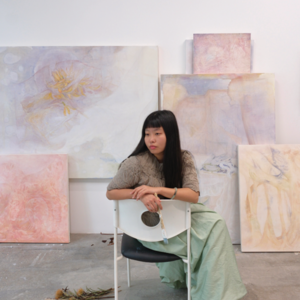
Xu Zehui (b. 1998, China) Lives and works between Venice and China. She graduated from the Painting Department of Accademy of fine art of Venice, where she studied under Carlo di Raco. In 2022, she participated in the Erasmus exchange program at Bath Spa University. In 2024, she received the First Prize at the 106th Collective Exhibition of Young Artists organized by Fondazione Bevilacqua La Masa.
Her work has been exhibited internationally, including solo exhibitions in Verona and Moscow, as well as group exhibitions in South Korea, Spain, and Germany. She has also participated in residency programs and international internship projects connected to the Venice Biennale and the Peggy Guggenheim Collection.
Artist Statement: Archaeology of Inner Landscapes and Poetic Dwelling In a noisy and fragmented world, how can we find our own "poetic dwelling"?
My artistic practice is rooted in the deep exploration of the multidimensional construction of "inner space." To me, space is not a static physical container, but a fluid field interwoven with memory, identity, and personal experience.
My painting methodology begins with fabric imprints as a foundational layer, initiating a visual archaeology. My long-term experience living in Italy has deeply fascinated me with the tension between "disappearance and presence" found in Italian frescoes. The erosions, oxidations, and fading colors left by the passage of time on ancient murals constitute the "folds of history." This visual language has shaped my understanding of the materiality of painting: I regard the canvas as a "wall" with historical thickness, simulating the process of temporal erosion through continuous layering and erasure.
Methodologically, I am inspired by Marcel Proust' s theory of "involuntary memory." He reminds me that the most profound truths often emerge from unexpected sensory triggers. Thus, shades of pink, blue, and violet drift across my canvas like fragments of half-forgotten dreams, composing what I call an "inner landscape." This is a meditative practice of "self-healing": by both concealing and revealing figurative elements, I maintain the painting in a state of "becoming" rather than "completion," capturing the fragile yet persistent, intimate yet shareable nature of memory.
Influenced by Fernando Pessoa' s notion of the "multiple selves," I view each work as a room within an inner landscape: it is simultaneously a mirror of the self and a shelter for the soul, carrying my ongoing search for home and belonging amidst cross-cultural experiences.
My work is not confined to personal experience; it opens toward the viewer, inviting them into an inner space where presence and absence, lightness and heaviness intertwine. During the residency in Regensburg, I hope to use this field to transform personal reminiscence into collective resonance. Thus, painting transcends self-dialogue, becoming a site for both self-healing and shared experience.